

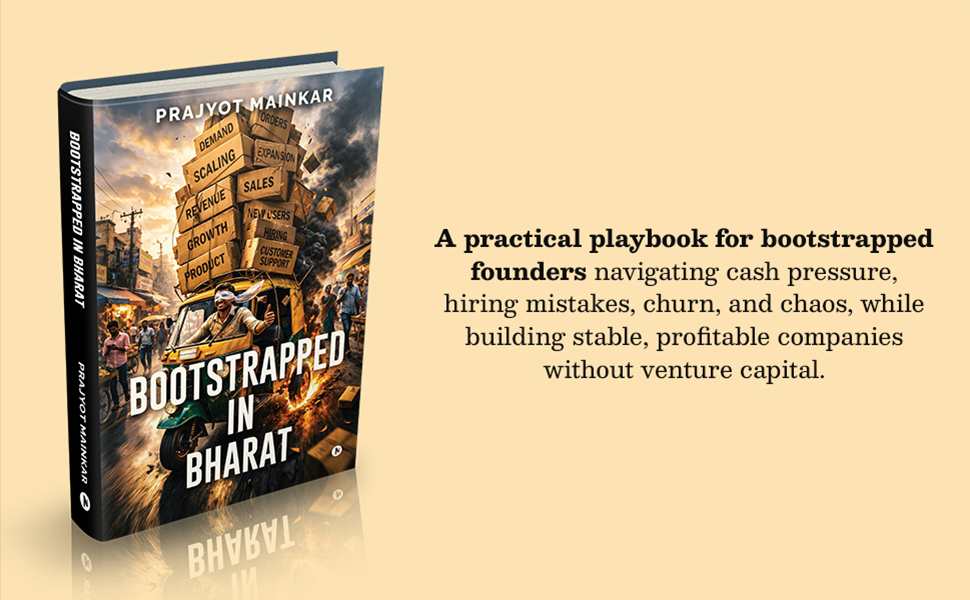
Building a business looks exciting from the outside. You see the launch announcements, growing teams, new customers, and revenue milestones. But there is another side to entrepreneurship that people don’t talk about as much.
What happens when a client delays payment? What if your biggest customer decides to leave? How do you hire the right people without putting pressure on your cash flow? And how do you keep a business running when every important decision eventually comes back to you?
These are some of the questions that inspired Prajyot mainkar to write Bootstrapped in Bharat.
Prajyot Mainkar is an entrepreneur, technology professional, and founder of SoFueled, based in Goa, India. Over the years, he has worked with businesses, mentored startup founders, and been involved in the Indian startup ecosystem. Through these experiences, he has seen that building a company involves much more than having a good idea or raising money.
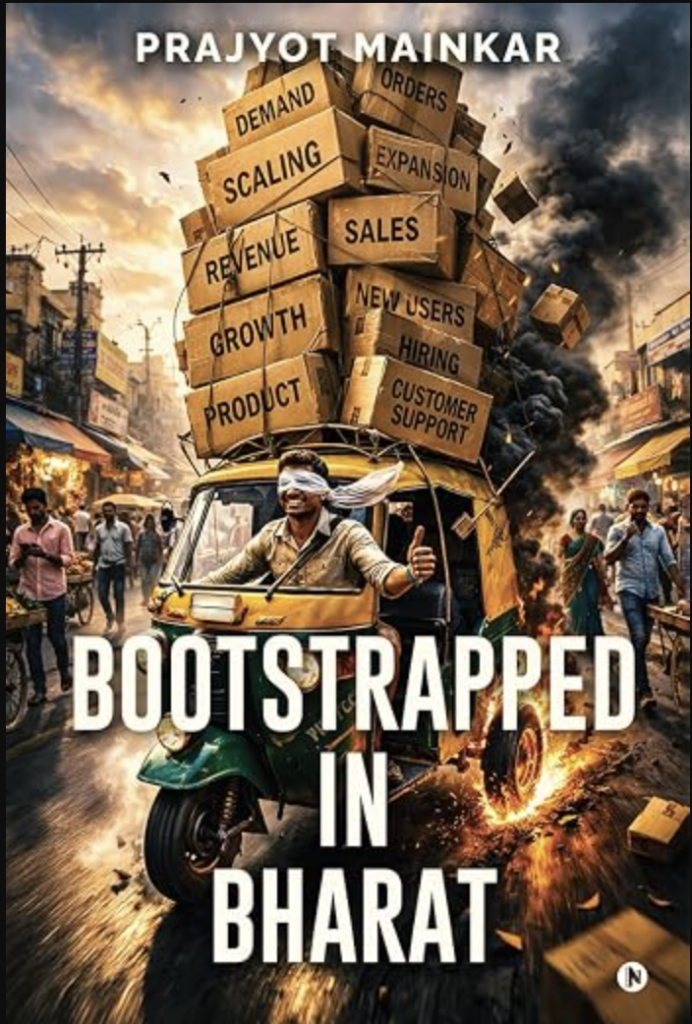
Bootstrapped in Bharat is about the realities of building and running a business, especially when you have to make the most of the resources available to you.
Whether you’re a first-time entrepreneur, an experienced founder, a small business owner, or someone thinking about starting a company in India, this book explores the problems that come with building something of your own.
What Is Bootstrapped in Bharat About?
Bootstrapped in Bharat is a business and entrepreneurship book about the challenges founders face while building sustainable companies.
The book focuses on the everyday problems that can determine whether a business remains healthy as it grows. These problems don’t always make headlines, but they affect founders across industries.
Think about a company that has plenty of work but struggles to collect payments on time. Or a founder who keeps hiring because the business is growing, only to realise that the additional costs are putting pressure on profitability.
These situations are familiar to many entrepreneurs. They are also reminders that revenue alone doesn’t tell the whole story of a business.
The book explores topics such as:
- Cash flow management and financial discipline.
- Business profitability and unit economics.
- Finding customers and improving sales.
- Client dependency, customer retention, and churn.
- Marketing, positioning, and reducing buyer hesitation.
- Hiring employees and building effective teams.
- Better meetings, communication, and decision-making.
- Reducing founder dependency through systems and processes.
- Using artificial intelligence to improve productivity.
- Building operational stability and a sustainable business.
- Making better decisions as a founder.
- Creating long-term business value and founder wealth.
The idea isn’t to present entrepreneurship as an easy journey. It is to help founders recognise common business problems and approach them with better systems, clearer thinking, and more informed decisions.
Who Should Read Bootstrapped in Bharat?
The book is written for people who are building businesses or planning to start one.
Startup founders and entrepreneurs
If you’re building a startup, you’ll eventually have to make decisions about customers, pricing, hiring, marketing, and growth.
You might have a promising product and a growing customer base, but what happens when your expenses grow faster than your revenue?
Bootstrapped in Bharat explores the operational and financial realities that founders need to understand while building a business.
Bootstrapped startup founders
Not every startup raises venture capital, and not every founder wants to follow the same growth path.
Some businesses grow using their own savings, customer revenue, and profits generated by the business. This approach is commonly known as bootstrapping.
Bootstrapped founders need to pay close attention to cash flow, expenses, customer payments, and the return on every investment they make.
If you’re building a company without external funding, the book explores several of the practical challenges that come with that responsibility.
Small business owners and business operators
Many of the problems discussed in the book aren’t limited to technology startups.
A service business, consultancy, agency, or established small business can face similar challenges around profitability, customer retention, hiring, and operational efficiency.
Growing revenue is important, but building a business that can operate consistently without the founder handling every little thing is equally important.
IT services companies and software agency founders
Technology services businesses often begin with a few clients and a small team. As the company grows, the founder may become responsible for sales, delivery, hiring, client relationships, and business operations.
This can work for a while, but it becomes difficult to scale when too many decisions depend on one person.
The book explores issues around client relationships, operational stability, hiring, and building better systems, which are particularly relevant to founders of IT services companies and software development agencies.
First-time entrepreneurs in India
Starting a business can feel confusing when you’re trying to understand everything at once.
You need to find customers, manage money, hire people, market your services, and make decisions despite uncertainty.
For first-time entrepreneurs and aspiring startup founders in India, understanding these practical challenges can be as important as understanding the original business idea.
Why he Wrote This Book
Prajyot has spent years working in technology and entrepreneurship, building a company, participating in the startup ecosystem, and helping other founders navigate their journeys.
One thing becomes clear when you spend enough time around businesses: many problems repeat themselves.
A founder struggles to collect payments. Another hires too quickly. Someone builds a service business that depends entirely on a few large clients. Another keeps attending meetings but struggles to turn discussions into decisions.
The circumstances differ, but the underlying problems often have patterns.
Prajyot wanted to write a book that talks about these realities without pretending that entrepreneurship is always exciting or that every challenge has a simple solution.
Bootstrapped in Bharat looks at the less glamorous side of building a business: the difficult decisions, financial pressures, operational gaps, and responsibilities that come with being a founder.
The goal is to make these experiences easier to recognise and think through.
It isn’t about following somebody else’s startup playbook. It is about developing the ability to understand your business, identify its weaknesses, and make better decisions as it grows.
The Startup Journey from Goa to Bharat
Goa is often associated with tourism, beaches, and hospitality. But it also has entrepreneurs, technology companies, startup communities, and people building businesses for customers across India and around the world.
His own journey in technology and entrepreneurship has been closely connected to Goa.
Through his work at SoFueled, his involvement in technology communities, and his engagement with startup founders and the wider ecosystem, he has seen the importance of building opportunities beyond India’s traditional technology hubs.
The startup ecosystem in Goa has its own opportunities and challenges. Founders may be building software products, technology services businesses, consumer brands, or companies serving customers in other markets.
Regardless of the industry, many of the fundamental questions remain the same.
How do you find customers? How do you build a profitable business? How do you hire well? How do you manage cash flow? And how do you build systems that allow the business to grow without depending on the founder for everything?
These are not questions limited to Goa. They are relevant to entrepreneurs across Bharat.
He believes the experiences of founders from different cities, backgrounds, and industries deserve to be part of the wider conversation about entrepreneurship in India.
What Does It Mean to Bootstrap a Business?
Bootstrapping means building and growing a business primarily through your own resources and the revenue the business generates, rather than relying on external equity funding.
For some founders, this means starting with personal savings. For others, it means using customer revenue to fund the next stage of growth.
Bootstrapping can offer founders greater ownership and control over their decisions. It can also require difficult trade-offs because resources are limited and there may be less room for expensive mistakes.
A founder may need to think carefully before hiring, investing in marketing, developing a new product, or entering a new market.
But bootstrapping isn’t simply about spending less money. It also involves understanding the economics of the business.
Are customers paying enough for the value you provide? Are you making a profit after accounting for delivery costs? Are your customers staying with you? Can the business operate reliably as it grows?
These questions matter whether you’re building a software startup, an IT services company, a consultancy, or another type of business.
Bootstrapped in Bharat explores the practical realities behind these decisions and the importance of building a business that can sustain itself over time.
AI, Business Automation, and the Future of Startups
Artificial intelligence is changing how businesses work, but adopting AI doesn’t automatically make a business more profitable.
Founders still need to understand their customers, manage their finances, make good hiring decisions, and build reliable operations.
AI can help with specific tasks, including information processing, customer support, repetitive workflows, and business productivity. The challenge is identifying where it can genuinely help rather than using it simply because it is popular.
This is especially relevant for small businesses and startups that need to use their time and resources carefully.
I’ve also been exploring these subjects through my writing on AI consulting, chatbots, and business automation.
If you’re interested in applying these ideas to your business, read my articles on AI consulting companies in Goa and WhatsApp chatbots for businesses in Goa.
About the Author: Prajyot Mainkar
Prajyot Mainkar is a Goa-based entrepreneur, author, and technology professional.
He is the Founder and CEO of SoFueled, an IT development company based in Goa. His work has involved mobile technology, software development, community building, entrepreneurship, and supporting the growth of the technology ecosystem.
He founded the Goa Android User Group and helped grow it from around 100 members to more than 35,000. He has also mentored startup founders and participated in initiatives connected to technology education and startup development.
His interests extend beyond building technology. I’m interested in understanding how businesses work, how founders make decisions, and how companies can build systems that help them grow sustainably.
Bootstrapped in Bharat brings together that interest in entrepreneurship and the practical realities of running a business.
You can learn more about my background and work on the About Prajyot Mainkar page.
Get Your Copy of Bootstrapped in Bharat
If you’re building a startup, running a small business, or planning your next entrepreneurial venture, Bootstrapped in Bharat explores the challenges that come with turning an idea into a sustainable business.
It is written for founders who want to understand the realities of entrepreneurship, improve the way they run their companies, and make more informed decisions as they grow.
Book: Bootstrapped in Bharat
Author: Prajyot Mainkar
Publisher: Notion Press
Category: Business, Entrepreneurship, and Startups
Explore the book and find the available editions through the book’s official listing and online booksellers.
- Amazon – Bootstrapped in Bharat by Prajyot Mainkar
- Google Books – Bootstrapped in Bharat by Prajyot Mainkar
- Google Play Books – Bootstrapped in Bharat