

Goa has built a strong identity around tourism, hospitality, and its distinctive cultural heritage. But as the state looks to attract investment and strengthen its business ecosystem, a larger question is emerging: can Goa become a destination not just for visitors and investors, but also for businesses that build, innovate, export and scale globally?
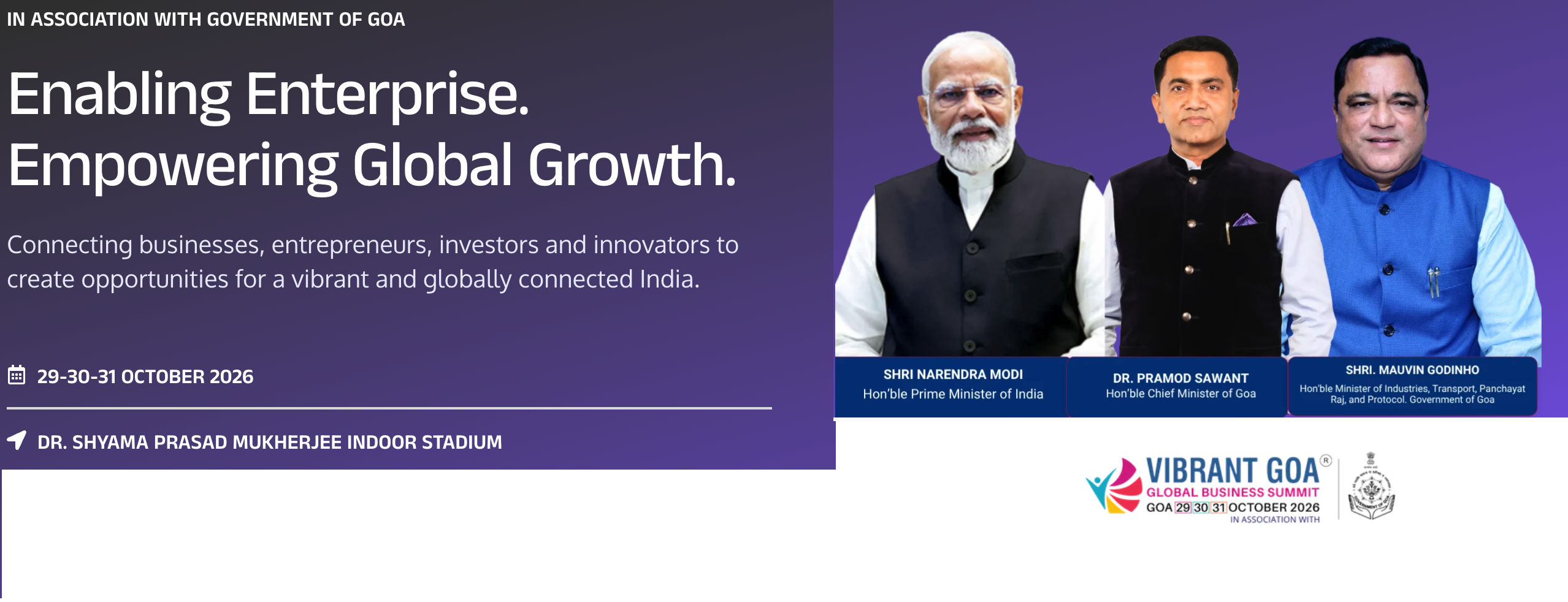
The question is particularly relevant as the Vibrant Goa Global Business Summit 2026 brings together entrepreneurs, investors, policymakers and business leaders from India and overseas. Being held from October 29 to 31, the summit aims to connect Goan businesses with international markets and create opportunities across sectors.
There are useful lessons Goa can draw from other investment-led initiatives, including Vibrant Gujarat. Prajyot Mainkar, founder of SoFueled, has had an opportunity to engage with that ecosystem as a jury member at Vibrant Gujarat. His experience in the technology sector, 16 years of involvement with GDG Goa, and work mentoring startup founders through initiatives such as EDC IGNITE and Startup Village provide an interesting lens through which to examine Goa’s next phase of economic development.
The opportunity is not to replace tourism with technology or replicate another state’s industrial model. It is to build an economy in which existing businesses become more productive, startups find larger markets, skilled professionals have meaningful opportunities, and companies founded in Goa can compete well beyond the state’s borders.
That is what a more vibrant Goa should ultimately look like.
Goa’s economy needs to grow beyond its traditional strengths
Tourism remains one of Goa’s most important economic engines. The state recorded approximately 10.8 million tourist arrivals in 2025, according to the Goa Tourism Department. Hospitality, restaurants, transport, entertainment and local retail businesses all benefit from this activity.
But an economy that depends heavily on one dominant sector is exposed to changes in travel patterns, global economic conditions, seasonality and consumer preferences.
Goa already has other economic foundations to build on. Manufacturing, pharmaceuticals, food processing, fisheries, logistics, education, professional services and information technology all offer opportunities for growth.
The state’s economic data reflects this diversity. The Goa Economic Survey reports that the secondary and tertiary sectors remain significant contributors to the state’s economy. The challenge is not necessarily to discover entirely new sectors, but to help existing ones become more productive, competitive, and capable of reaching larger markets.
Tourism can remain a strength while technology, manufacturing, services and entrepreneurship create additional sources of income and employment.
The Vibrant Gujarat lesson: ambition must translate into execution
Vibrant Gujarat demonstrated how a state can use an investment summit to create a platform for engagement between governments, investors, businesses and international stakeholders.
However, the real value of such initiatives cannot be measured only by the number of delegates, announcements, or memoranda of understanding. The more important question is what happens after the event: how many proposals move forward, how many businesses begin operations, how many jobs are created, and how much of the investment translates into sustained economic activity.
Goa’s opportunity is to develop its own model.
The state does not need to compete with larger industrial economies on land availability, population or scale. It can compete through focused sectors, quality of life, specialised talent, entrepreneurship, access to international markets and a business environment that makes it easier to establish and operate companies.
For Vibrant Goa to have a lasting impact, the summit must become more than a three-day meeting. It should create relationships and commitments that continue through the year.
MSMEs: the foundation of Goa’s business economy
One of the most important parts of Goa’s economic story is its micro, small and medium enterprise sector.
According to the Goa MSME portal, the state had approximately 1.05 lakh registered MSMEs as of September 30, 2026. Around 98.5% of these were micro enterprises.
This is an important number, but it also highlights a challenge. Goa has a large base of small businesses, yet relatively few have the scale, systems, and market access needed to become significantly larger enterprises.
Many businesses operate with limited technology adoption, informal processes, fragmented distribution, and a dependence on local customers. They may have strong products or services but lack the systems needed to manage growth.
A food-processing business, for example, may have the potential to sell beyond Goa but struggle with inventory management, distribution, customer acquisition and compliance. A hospitality business may receive hundreds of enquiries but handle them manually across phone calls and messaging applications. A manufacturer may still rely on spreadsheets for procurement, production planning and stock management.
Goa’s traditional products also have opportunities beyond the local market. The state’s cashew industry, for instance, can benefit from better branding, quality assurance, digital distribution and access to buyers outside the state. A related look at the market for authentic Goa cashew nuts illustrates the importance of connecting local products with wider consumer demand.
These are not merely operational inconveniences. They affect margins, customer experience, and the ability to grow.
The next phase of Goa’s MSME development should therefore focus not only on starting businesses, but also on helping existing businesses become more competitive.
Technology is no longer optional for business growth
Digital transformation is often discussed as a large enterprise initiative. In reality, some of its most immediate benefits are available to smaller businesses.
A hotel can automate routine guest enquiries and booking-related communication. A manufacturer can use software to track inventory, production and procurement. A retailer can connect customer records, billing and repeat-purchase communication. A professional services firm can automate lead management, follow-ups and reporting.
Artificial intelligence is extending these possibilities.
Businesses can now use AI-powered tools to process documents, respond to routine enquiries, analyse customer feedback, support internal teams and reduce repetitive administrative work. The opportunity is not to introduce AI simply because it is fashionable. It is to identify business processes where automation can save time, improve accuracy or create a better customer experience.
For Goa’s hospitality sector, this could mean more responsive guest communication and better handling of enquiries across multiple channels. For manufacturers, it could mean improved quality monitoring, forecasting and operational visibility. For professional services, it could mean faster research, document processing and customer support.
Small businesses exploring these possibilities can start with practical workflows rather than expensive, large-scale technology projects. The article on AI automation for small businesses examines some of these applications in greater detail.
For hospitality businesses, AI automation for hotels in Goa can help address guest enquiries, booking follow-ups, and repetitive communication. Similarly, WhatsApp chatbot development can help businesses manage customer interactions on a channel many of their customers already use.
The businesses that benefit most will be those that identify practical problems and implement technology around them.

Can Goa become a destination for technology companies?
Goa has several advantages that could support a stronger technology and professional services ecosystem.
It offers a good quality of life, access to national and international connectivity, an established education network, and an emerging startup community. It is also home to professionals and entrepreneurs who have experience working with clients and companies outside the state.
Yet, a few constraints remain.
The local market is relatively small. Many technology companies depend on customers from other Indian cities or overseas markets. Specialised talent often moves to larger technology hubs, and companies can find it difficult to build teams in niche areas.
This makes the export of technology services particularly important.
Software development, mobile application development, cloud engineering, cybersecurity, data engineering, AI implementation and enterprise automation are services that can be delivered from Goa to customers across India and internationally.
A company does not necessarily need to be based in Bengaluru, Hyderabad, or Mumbai to serve a global customer. It needs the right talent, delivery capabilities, business development network and credibility.
Companies such as SoFueled, founded by Prajyot Mainkar, operate in this broader technology services space, working across software development, mobile applications and AI-enabled solutions. Its work spans areas such as AI in mobile applications, custom mobile app development, full-stack development and WhatsApp bot development.
The larger opportunity is to encourage more companies from Goa to build specialised capabilities, win customers outside the state and bring revenue back into the local economy.
Goa should aim to become a place where technology companies can be founded, built and scaled—not simply a place where technology professionals live while working remotely for companies elsewhere.
Startups need more than incubation and recognition
Goa’s startup ecosystem has made progress through policy support, incubation programmes, entrepreneurship initiatives and community-led events.
A Lok Sabha reply in July 2026 reported 861 DPIIT-recognised startups in Goa as of June 30, 2026. This is an encouraging indicator of entrepreneurial activity, although recognition numbers alone do not tell the complete story of the ecosystem.
The more important questions are:
- How many startups are generating sustainable revenue?
- How many are selling outside Goa?
- How many are creating specialised employment?
- How many are attracting private investment?
- How many are building products that can compete internationally?
- How many survive beyond their initial funding or incubation period?
Startup ecosystems are built through more than policy announcements. They require experienced mentors, early customers, access to capital, strong peer networks, industry partnerships and opportunities to test products in real business environments.
Prajyot Mainkar’s involvement with GDG Goa over 16 years and his work mentoring founders through initiatives such as EDC and IGNITE reflect the importance of community-led support. Technology communities, founder networks and industry connections can help bridge the gap between an idea and a commercially viable business.
His book, Bootstrapped in Bharat, also explores the journey of building businesses with limited resources and the importance of creating sustainable enterprises.
Goa needs more such connections between startups, established companies, educational institutions and government departments.
The AI opportunity: a new advantage for Goa’s businesses
Artificial intelligence could become one of the defining opportunities for Goa’s next phase of economic development.
The state has taken steps in this direction through the Draft Goa AI Policy 2026, which was released for public consultation. The draft signals an intention to explore AI adoption, innovation and the development of an AI-enabled ecosystem.
But the success of an AI policy will ultimately depend on implementation.
For businesses, the immediate opportunity is practical. AI can help hotels handle guest communication, help retailers understand customer behaviour, support manufacturers with quality and process analysis, and enable professional services companies to automate document-heavy workflows.
For government departments, AI could support citizen services, document processing, grievance management and better use of public data, provided that privacy, accountability and human oversight are built into the systems.
For startups, AI creates opportunities to build products for sectors where local knowledge matters. Goa’s tourism, hospitality, real estate, healthcare, education and manufacturing sectors offer potential use cases.
The state could also explore AI-focused skilling programmes, industry partnerships, startup grants and access to computing infrastructure. These initiatives should be linked to measurable outcomes rather than treated as standalone technology projects.
The draft AI policy is a starting point. The real test will be whether it leads to adoption, new businesses, skilled jobs, and measurable improvements in productivity.
Businesses evaluating AI adoption can also refer to this overview of AI consulting companies in Goa to understand the kinds of solutions and implementation capabilities available in the market.
What Goa needs to focus on next
A successful business summit should lead to a practical economic agenda. A few priorities deserve particular attention.
1. Help MSMEs become technology-enabled
Digital adoption programmes should help small businesses implement accounting systems, customer relationship management, inventory software, digital payments, automation and AI tools. Support should focus on measurable business outcomes rather than simply encouraging software adoption.
2. Build stronger links between industry and education
Goa’s colleges and technical institutions should work more closely with companies to develop industry-relevant skills. Students need exposure to real projects, internships, apprenticeships and emerging areas such as AI, cloud engineering, cybersecurity and data science.
3. Make it easier for businesses to operate
Investors and entrepreneurs look beyond incentives. They want predictable approvals, transparent processes, reliable infrastructure and clear timelines. Reducing friction in setting up and operating a business can be as important as offering financial incentives.
4. Encourage exports from Goa
Technology services, professional services, specialised manufacturing and food products can reach markets beyond the state. Export readiness, international buyer connections and industry-specific support can help local businesses grow.
5. Measure outcomes after investment summits
Investment announcements should be tracked through clear milestones: proposals converted into projects, projects that become operational, capital deployed, jobs created, and local businesses entering supply chains.
6. Develop a stronger technology and startup network
Mentorship, access to early customers, investor connections, and collaboration between established companies and startups can help founders move from experimentation to sustainable businesses.
Building a Goa that competes beyond its borders
The future of Goa’s economy does not have to be a choice between tourism and technology, or between preserving its identity and pursuing economic growth.
The state can build on its established strengths while creating opportunities in new sectors. Tourism businesses can become more technology-enabled. Manufacturers can adopt automation. MSMEs can reach customers in other markets. Startups can build products for global industries. Technology companies can deliver services internationally while creating skilled employment within Goa.
That requires a shift in ambition.
The Vibrant Goa Global Business Summit 2026 provides an opportunity to bring businesses, investors, policymakers and entrepreneurs into the same conversation. But its lasting success will be judged by what follows: the partnerships formed, companies established, investments realised, jobs created and businesses that find new markets.
Goa does not need to become another Bengaluru, Hyderabad or Gujarat. It needs to develop a model that reflects its own strengths and makes those strengths economically valuable.
The real measure of a vibrant Goa will not simply be how many investors visit the state. It will be how many businesses choose to build here, how many local enterprises grow into national and global companies, and how many opportunities are created for the next generation.
The opportunity is to make Goa not just a destination for people to visit, but a place where ambitious businesses choose to build their future.