


What Is the Mhajo Flat Scheme in Goa?
Buying a flat does not always mean that the legal transfer of the underlying land and building to the housing society has been completed.
In Goa, many apartment owners have possession of their homes and registered agreements for sale, but their housing societies may not have received a formal conveyance deed from the builder, developer or original landowner. This can create difficulties when societies need to establish ownership of common property, maintain records, undertake redevelopment or deal with property-related legal matters.
To address this issue, the Government of Goa introduced Mhajo Flat, an initiative intended to help eligible co-operative housing societies secure conveyance of the land and building in their name, including cases where a builder or landowner does not cooperate.
The initiative is backed by amendments to Goa’s co-operative legislation and changes to the applicable stamp duty and registration framework.
The government formally launched the initiative in November 2026. At the launch, the Chief Minister said that government officers would step in to facilitate the execution of conveyance documents where builders or landowners failed to cooperate after the prescribed notice process.
For flat owners who have been waiting for their housing society to obtain a conveyance deed, this is an important development.
Why Is a Conveyance Deed Important for Flat Owners?
When a person purchases an apartment, the transaction generally involves an agreement for sale and other documents recording the purchase.
However, the conveyance of the land and building to the co-operative housing society is a separate and important part of the ownership process.
A conveyance deed formally transfers the relevant title and property interests to the society. Without it, a society may face difficulties in establishing its legal position concerning the land and common areas.
This can become particularly important when:
- The original builder or developer has stopped responding.
- The landowner is unavailable or unwilling to sign the conveyance deed.
- The developer has completed the project but has not transferred the property to the society.
- The housing society needs to undertake major repairs or redevelopment.
- Members need clarity regarding ownership of the land and common areas.
- The society needs to maintain proper legal and property records.
The Mhajo Flat initiative seeks to address this long-standing problem by providing an administrative route for eligible societies to pursue conveyance.
What Is the Legal Framework Behind Mhajo Flat?
The initiative is supported by amendments to the Goa Co-operative Societies Act, 2001, and related changes to the state’s stamp duty and registration framework.
There are several important legislative and administrative developments.
July 2026: Ordinance and financial concessions
On 6 July 2026, the Government of Goa published an ordinance amending the Goa Co-operative Societies Act.
The government also issued a Revenue Department order providing concessional stamp duty for unilateral deemed conveyance. A separate registration-related notification addressed the applicable registration fee.
These measures created the initial legislative and financial framework for the initiative.
September 2026: Amendment Act
The Goa Legislative Assembly subsequently passed the Goa Co-operative Societies (Amendment) Act, 2026.
The final amended legislation provides for the responsibility of the chairman or an office-bearer of a co-operative housing society to take the necessary steps to complete the transfer of the land title from the landowner, builder or developer into the society’s name within three months of the society’s registration.
The office-bearers must also file a copy of the registered conveyance with the Registrar.
It is important to distinguish this statutory responsibility from the government’s separately announced intervention process for cases where the builder or landowner does not cooperate.
November 2026: Formal launch of Mhajo Flat
The Chief Minister formally launched the Mhajo Flat initiative on 16 November 2026.
During the launch, the government explained that where a builder or landowner fails to cooperate after the prescribed notice process, the Cooperative Department would facilitate execution of the conveyance documents through its authorised officers.
The government also announced that 11 housing complexes had come forward with applications on the launch day.
This marked the transition from the legislative framework to the scheme’s implementation.
Who Can Apply for the Mhajo Flat Scheme?
The initiative is primarily intended for co-operative housing societies in Goa that have not received a formal conveyance or title deed for their property.
Potential beneficiaries include:
- Registered co-operative housing societies that do not have a conveyance deed.
- Societies whose builders or developers have failed to execute the conveyance.
- Housing societies where the original landowner is unavailable or unwilling to cooperate.
- Societies where the builder has ceased operations or cannot be contacted.
- Eligible apartment complexes that need to complete the process of forming a co-operative housing society.
The government has also encouraged flat owners to organise themselves and form co-operative housing societies where necessary.
Important: Individual flat owners should check their building’s legal and registration status before assuming that they can directly apply under the scheme. The scheme’s administrative route is centred on the housing society and its registration.
How Does Unilateral Deemed Conveyance Work in Goa?
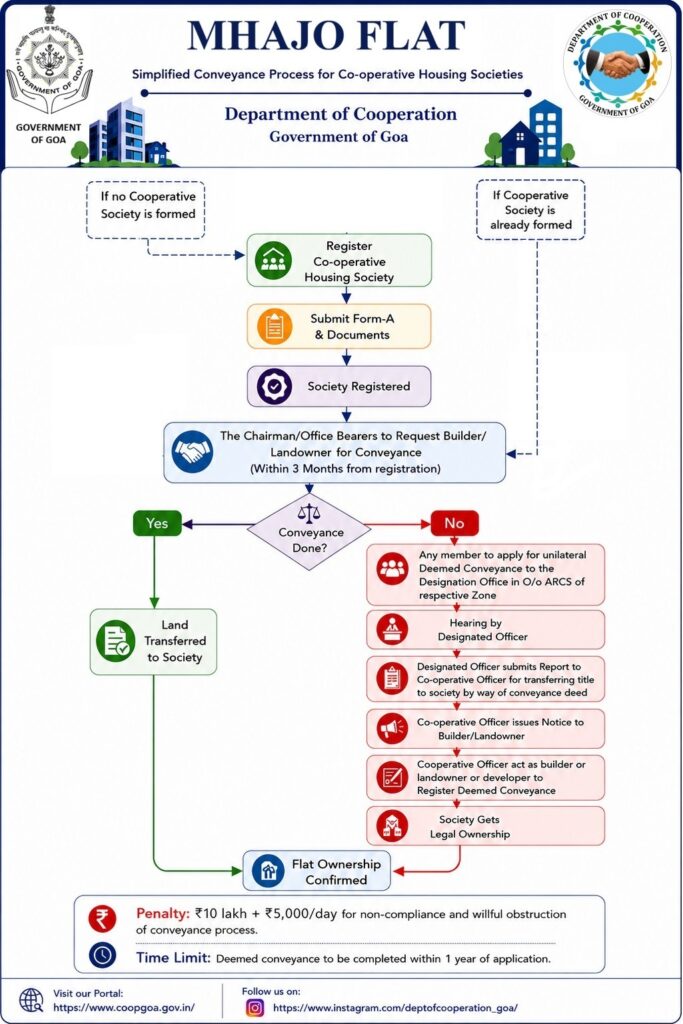
Under the process explained by the government, an eligible housing society can pursue conveyance even when the builder or landowner does not cooperate.
The government’s November launch announcement described the intervention process as follows: after the required notice period, authorised officers of the Cooperative Department can step in to facilitate the execution of the conveyance documents on behalf of a non-cooperating party.
The practical process can be understood in the following stages.
Step 1: Ensure that the housing society is registered
The apartment owners should first establish whether their building has a registered co-operative housing society.
If the society has not been registered, the members should approach the Department of Cooperation and understand the applicable registration procedure.
The society’s registration documents and members’ property records will be important for the subsequent application.
Step 2: Approach the builder or landowner
The society should initiate the process of obtaining the conveyance deed from the builder, developer or landowner.
The request and any response should be properly documented.
The government has referred to a three-month notice process before its officers intervene in cases of non-cooperation. The society should obtain the latest prescribed notice format and instructions from the Department of Cooperation rather than relying on an informal letter.
Step 3: Submit the application to the designated authority
If the builder or landowner fails to cooperate, the society can approach the designated authority under the government’s implementation framework.
The Government of Goa has appointed zonal designated officers to process applications relating to unilateral deemed conveyance.
The society should submit the prescribed application along with its supporting property and society documents.
Step 4: Verification and inquiry
The authorities examine the application, supporting agreements, society records and relevant property documents.
The concerned parties may be notified and given an opportunity to respond, as required under the applicable procedure.
The purpose of this process is to establish whether the case qualifies for the government-facilitated conveyance route.
Step 5: Execution and registration of the conveyance
Where the application is approved and the statutory requirements are satisfied, the authorised officer can facilitate execution of the conveyance documents in accordance with the applicable legal process.
The deed must then be presented for registration before the competent Sub-Registrar.
Once registered, the society should preserve the conveyance deed and update its property records.
Note: The exact application forms, notice requirements, inquiry procedure and document requirements should be confirmed with the relevant zonal office. The process may also differ depending on the society’s registration status and the nature of the property’s title records.
What Is the Stamp Duty Under the Mhajo Flat Scheme?
One of the important features of the initiative is the concessional stamp duty structure introduced by the Department of Revenue.
The Government of Goa issued an order dated 6 July 2026 specifying fixed stamp duty amounts for unilateral deemed conveyance, depending on the nature of the unit and its location category.
The amounts are charged on each residential unit, commercial unit or amenity/ancillary area, irrespective of its built-up area.
Stamp duty for unilateral deemed conveyance
| Nature of unit/property | Category A | Category B | Category C |
|---|---|---|---|
| Residential unit | ₹50,000 | ₹40,000 | ₹30,000 |
| Commercial unit | ₹1,00,000 | ₹80,000 | ₹50,000 |
| Amenities / ancillary areas | ₹10,000 | ₹7,500 | ₹5,000 |
What are Category A, B and C areas?
The stamp duty depends on the location category notified by the Government of Goa.
Category A
This includes coastal village panchayat areas and areas under the jurisdiction of the Corporation of the City of Panaji and the Municipal Councils of Mapusa, Ponda, Vasco-da-Gama and Margao.
Category B
This includes notified census towns, village panchayat areas adjoining Category A areas and other municipal council areas not included in Category A.
Category C
This covers village panchayat areas that are not classified under Category A or Category B.
The official notification includes a detailed taluka-wise annexure listing the towns and villages under the three categories. Housing societies should check the notified classification of their specific property rather than relying only on the broad descriptions above.
What Is the Registration Fee?
The government has also notified a concessional registration fee of ₹10,000 for unilateral deemed conveyance.
This is separate from the applicable stamp duty.
The actual amount payable by a society will depend on the nature of the units and ancillary areas covered by the conveyance and the applicable government notifications.
The society should obtain confirmation from the registration authority before making payment.
Documents Required for the Mhajo Flat Application
A housing society should keep its records organised before approaching the Department of Cooperation.
The following documents are useful to prepare. The final list should be checked against the prescribed application form and the latest departmental instructions.
Society documents
- Registration certificate of the co-operative housing society.
- Society bye-laws.
- Resolution authorising the application and identifying the authorised office-bearers.
- List of society members and their respective units.
- Relevant resolutions passed by the managing committee or general body.
Flat ownership documents
- Registered agreement for sale of the applicant or original purchaser.
- Copies of registered agreements for sale of other society members.
- Subsequent sale or transfer documents, wherever applicable.
- Share certificates issued by the society, where available.
Property and building documents
- Occupancy certificate, where available.
- Approved building plans and construction permissions.
- Property Registration Card or relevant survey records.
- Survey plan, chalta details and other land identification documents.
- Land title documents and available ownership records.
Correspondence with the builder or landowner
- Copies of notices or written requests seeking execution of the conveyance deed.
- Replies received from the builder or landowner, if any.
- Records showing attempts to contact the concerned parties.
Keeping these documents organised can help the society avoid unnecessary delays during verification.

Where Can Housing Societies Apply for Mhajo Flat in Goa?
The Government of Goa has appointed zonal designated officers to process applications under the relevant framework.
The notified zonal structure includes:
| Zone | Location |
|---|---|
| North Zone | Mapusa |
| Central Zone | Panaji |
| Bicholim Zone | Sankhali |
| Ponda Zone | Ponda |
| South Zone | Fatorda / Margao |
| Quepem Zone | Quepem |
Housing societies should contact the Department of Cooperation or the Office of the Registrar of Co-operative Societies to confirm the current officer, application procedure and submission location for their area.
The government has also indicated that special camps and administrative support will be organised to help eligible societies.
For the latest notifications, application instructions and officer details, refer to the Government of Goa Orders and Circulars.
How Can Mhajo Flat Help with Future Redevelopment?
A registered conveyance deed can be important when a housing society considers redevelopment or reconstruction.
When the society has a clearer legal position regarding the land and building, it is better placed to examine redevelopment proposals, negotiate with developers and take decisions through its members and governing bodies.
However, obtaining conveyance does not automatically approve redevelopment or resolve every dispute relating to the property.
Societies must still comply with applicable planning permissions, building regulations, member approvals and other legal requirements.
The conveyance process should therefore be seen as an important step towards establishing the society’s property rights, rather than a blanket approval for future construction.
How Digital Records Can Help Housing Societies Manage Property Documents
The Mhajo Flat initiative also highlights a practical issue that many housing societies face: the need to maintain accurate and accessible records.
Societies often deal with documents accumulated over many years, including agreements for sale, member records, share certificates, property plans, maintenance records, resolutions and correspondence with developers.
When these records are scattered across physical files, email accounts and individual office-bearers’ devices, retrieving the right document can become difficult.
Digital document management systems and member portals can help housing societies:
- Maintain a central repository of property and society documents.
- Organise member and unit records.
- Track maintenance collections and outstanding payments.
- Record complaints and maintenance requests.
- Maintain digital copies of committee resolutions and meeting records.
- Provide authorised members with access to relevant documents.
SoFueled, a Goa-based software engineering studio, builds custom web applications, mobile applications and workflow automation solutions. These capabilities can be adapted to the administrative needs of housing societies, including member portals, document management systems and maintenance workflows.
Learn more about SoFueled or explore its custom mobile app development services.
These technology solutions can support administration and record-keeping; they do not replace legal advice, property-title verification or statutory compliance.
Frequently Asked Questions About Mhajo Flat Goa
1. What is the Mhajo Flat Scheme in Goa?
Mhajo Flat is a Government of Goa initiative intended to help eligible co-operative housing societies obtain conveyance of the land and building in their name, including cases where builders or landowners do not cooperate.
2. What is unilateral deemed conveyance?
Unilateral deemed conveyance is a legal and administrative mechanism through which conveyance can be facilitated without the voluntary execution of the deed by the builder or landowner, subject to the applicable law and approval process.
3. Who is eligible for the Mhajo Flat Scheme?
The initiative primarily benefits co-operative housing societies in Goa that do not have a formal conveyance deed for their property. Societies should confirm their eligibility and registration status with the Department of Cooperation.
4. Can a housing society obtain conveyance if the builder is missing?
The government has announced that authorised officers can intervene where the builder or landowner fails to cooperate after the prescribed notice process. The society must still complete the required application and verification procedure.
5. What is Section 104B of the Goa Co-operative Societies Act?
Section 104B, as substituted by the 2026 amendment, requires the chairman or an office-bearer of a co-operative housing society to take the necessary steps to complete the transfer of land title from the landowner, builder or developer into the society’s name within three months of the society’s registration. A copy of the registered conveyance must also be filed with the Registrar.
6. What is the stamp duty for deemed conveyance in Goa?
The notified stamp duty depends on the location category and type of property. For residential units, the rates are ₹50,000 in Category A, ₹40,000 in Category B and ₹30,000 in Category C. The amounts apply per residential unit.
7. What is the registration fee under Mhajo Flat?
The notified concessional registration fee for unilateral deemed conveyance is ₹10,000, separate from stamp duty.
8. Does the scheme apply to commercial units?
The Revenue Department’s stamp duty notification includes commercial units and amenities or ancillary areas in its concessional fee table. Whether a particular society or property qualifies for the scheme should be confirmed with the competent authority.
9. Does the scheme automatically transfer individual flats into the names of their owners?
The initiative focuses on conveyance of the relevant land and building title into the name of the co-operative housing society. It should not be confused with a fresh individual sale or transfer of each flat.
10. Does obtaining a conveyance deed resolve every property dispute?
No. A conveyance deed is an important step in establishing the society’s legal position, but it does not automatically settle every dispute involving the original land title, ownership claims, boundaries, planning permissions or other legal matters. Such issues may require separate legal proceedings or administrative approvals.
Conclusion: A Significant Step Towards Securing Flat Ownership in Goa
For many apartment owners in Goa, the absence of a conveyance deed has remained an unresolved issue long after they purchased their homes.
The Mhajo Flat initiative provides a government-backed route for eligible housing societies to address this problem, particularly where builders or landowners have failed to cooperate.
The concessional stamp duty and registration fee structure can also reduce the financial burden associated with completing the process.
Housing societies should begin by reviewing their registration status, organising their property documents and contacting the appropriate zonal office of the Department of Cooperation for the latest application requirements.
For flat owners who have been waiting years for their society to secure the conveyance deed, this is an opportunity to take the next step towards formalising the property’s legal records.
Disclaimer: This article is for general information and awareness. It is not legal advice. Eligibility, procedural requirements, applicable fees and the legal effect of conveyance depend on the facts of each property and the current laws, notifications and departmental instructions. Societies should verify the latest requirements with the Department of Cooperation, the relevant registration authority and a qualified property lawyer.